

“Flushable” is a claim that gets validated in seconds. You use the wipe, you flush, and the system accepts it without protest. No backup, no warning, no reason to doubt what the packaging promised.
The problem is, plumbing systems are not designed to fail in real time.
Across Bellingham, Arlington, and the wider North Sound region, plumbing professionals are seeing the same story play out repeatedly. Systems that were functioning without issue begin backing up, draining slowly, and eventually failing in ways that are neither cheap nor convenient to fix. In a significant number of those cases, the investigation leads back to a product that claimed to be safe to flush.
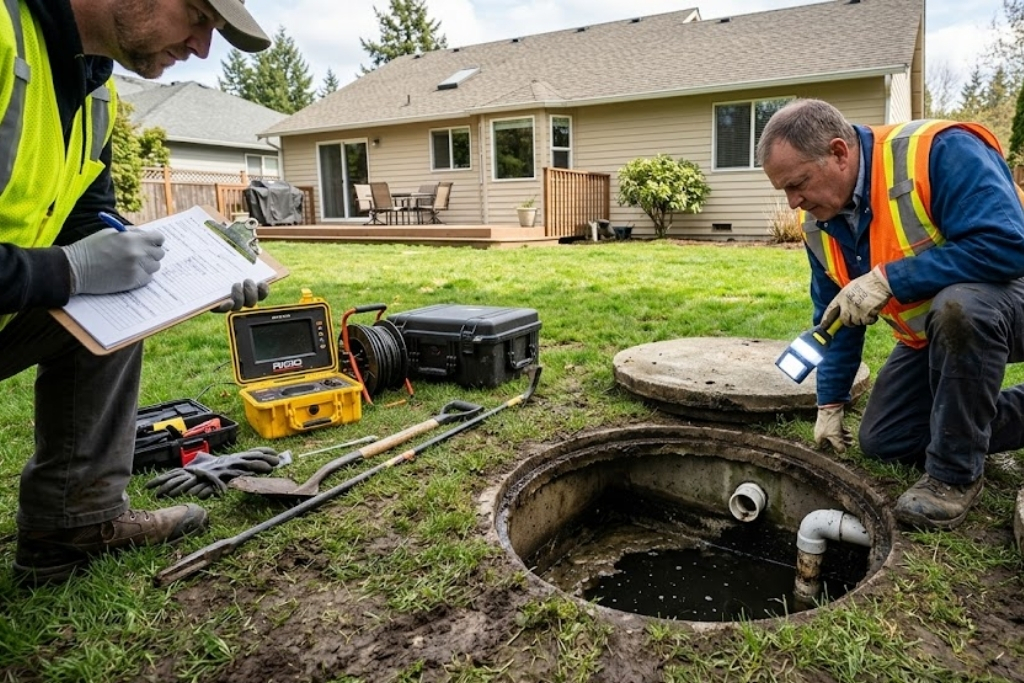
Professionals who handle septic tank inspection, cleaning, and pumping services in areas like Bellingham and Arlington consistently identify so-called flushable wipes as a leading contributor to toilet backups, main sewer line clogs, and long-term system deterioration.
This blog takes you inside the tank to explain what inspectors actually find and why the problem is more serious than most homeowners realize.
Are “Flushable” Wipes Truly Safe for Your Plumbing?
The word flushable on a product label describes what a manufacturer is willing to claim, not what the plumbing system is actually designed to handle.
Toilet paper is engineered specifically to fall apart in water within seconds. Wipes are engineered to hold together during use, and that structural durability does not disappear the moment they are flushed.
| Feature | Toilet Paper | “Flushable” Wipes |
| Breakdown time | Seconds to minutes | Hours to days, often longer |
| Material composition | Natural paper pulp | Synthetic fibre blends |
| Risk of clogging | Low | High |
| Septic system compatibility | Yes | No |
The U.S. Environmental Protection Agency has identified non-dispersible materials as a major contributor to sewer system failures, noting that materials that do not dissolve quickly tend to accumulate progressively rather than passing through safely. The plumbing problems that follow from flushable wipes are not a matter of if. They are a matter of when.
What Plumbing Inspectors Actually Discover Inside Tanks and Pipes
Wipe Clumps That Do Not Break Down
When wipes enter a septic tank, they do not sit there quietly as individual items. They bind together with grease, hair, and accumulated debris to form dense, fabric-like masses that restrict flow and trap additional waste as more material passes through.
What these clumps lead to:
- Restricted water flow throughout the system
- Increased buildup that compounds over time
- A much higher likelihood of recurring toilet clogs that keep returning, regardless of how many times they are cleared
Professionals performing septic tank pumping service in areas like Arlington regularly pull out masses of wipes that have remained structurally intact for months inside the tank.
Damage to Internal Tank Components
A septic system depends on a working balance between bacterial activity and mechanical flow. Wipes interfere with both sides of that equation by wrapping around baffles and filters, reducing system efficiency and accelerating wear on components that were not designed to handle fabric-like debris.
Over time, this creates an increased need for septic tank cleaning service and more frequent full inspections to manage what has quietly accumulated.
Sewer Line Clogs and Household Backups
Wipes that make it past the tank tend to settle in the pipes downstream, particularly in older systems found across Arlington and surrounding communities. What you end up with is slow drainage, toilets that gurgle, and backups that feel random but have quietly been building for a while. Ignore the warning signs, and things can spiral fast into full-blown emergency plumbing territory.
The Larger Issue: Municipal Sewer Systems Under Pressure
The problem extends beyond individual homes. Cities across the United States are spending millions of dollars each year to address wipe-related blockages.
According to the National Association of Clean Water Agencies:
- Utilities spend over $440 million annually to manage wipe-related damage.
- Wipes are a leading contributor to sewer overflows.
Similarly, the New York City Department of Environmental Protection has reported that wipes make up a significant portion of the debris removed from sewer systems.
Those numbers reflect the growing concern around flushable wipes clogging pipes across both private and public systems.
Why Wipes Do Not Break Down Like Toilet Paper
The core issue is straightforward: design intent. Toilet paper is made to dissolve. Wipes are made to endure. Those two design goals are fundamentally incompatible with each other in a plumbing system.
| Property | Toilet Paper | Wipes |
| Fiber type | Natural, dissolvable | Synthetic blends built to last |
| Water solubility | High, breaks down quickly | Low, retains structure |
| Structural strength under moisture | Weakens almost immediately | Remains largely intact |
| Long-term septic impact | Minimal | Accumulative and progressive |
This is the reality behind the septic-safe wipes truth and the wipes vs toilet paper breakdown conversation. The difference is not a matter of degree. It is a matter of entirely different engineering goals.
Warning Signs That Wipes Are Causing Problems
Most homeowners do not connect a slow toilet to the wipes they flushed three months ago. By the time the connection becomes obvious, the system has usually been struggling for a while.
Early signs worth paying attention to:
- Toilets that flush more slowly than they used to
- Unpleasant odors near drains or around the septic area
- Water is pooling in areas of the yard near the system
- A growing need for drain cleaning services to keep things moving
- Clogged toilet repair calls that keep recurring without a clear explanation
Quick plumbing inspection checklist to run through:
- Are drains moving more slowly than they did six months ago?
- Has the system needed service more frequently recently?
- Have you heard gurgling sounds from the pipes?
- Has a backup occurred anywhere in the home recently?
More than one ‘yes’ is a reasonable prompt to book a professional sewer camera inspection before the situation worsens.
The Financial Impact of Flushing Wipes
The cost does not arrive all at once. It builds gradually through a pattern of increasingly frequent service calls and repairs that most homeowners do not immediately trace back to a flushing habit.
Where the expenses tend to accumulate:
- More frequent septic tank pumping service than the system would otherwise need
- Emergency repair costs for blockages that could not wait for a scheduled visit
- Sewer line cleaning to clear accumulations in the downstream pipes
- Replacement of internal components that have been worn down by debris they were never designed to handle
The Water Environment Federation has documented that maintenance costs rise significantly when non-flushable materials enter wastewater systems consistently over time. The savings from avoiding wipes are real, even if they are not immediately visible.
What If You Have Been Flushing Wipes?
The most useful thing about catching this problem early is that early intervention is considerably less expensive than reactive repair. If wipes have been part of the household routine, acting now is the right call.
Practical steps to take immediately:
- Stop flushing wipes from this point forward
- Watch the system over the following weeks for any changes in performance
- Schedule a professional inspection rather than waiting to see whether a problem develops
- Plan for regular maintenance to catch anything that has already accumulated
Professionals offering septic tank service can assess the current condition of the system and identify early-stage blockages before they require the kind of intervention that comes with a significantly larger bill.
Safer Alternatives to “Flushable” Wipes
Switching away from wipes does not have to mean sacrificing comfort. There are straightforward alternatives that work well without causing any downstream problems.
Better options for the bathroom:
- Standard toilet paper, which is designed from the ground up to dissolve
- Bidet systems, which eliminate the need for wipes entirely
- Any product clearly labelled as non-flushable, disposed of in a covered bin rather than the toilet
Keeping a small covered bin in the bathroom is a simple habit change that removes the temptation to flush anything that does not belong in the system. These are the non-flushable bathroom products and plumbing-safe toilet products decisions that protect the system over the long term.
How to Protect Your Plumbing System Over Time
Long-term plumbing health is built through consistent habits rather than reactive fixes.
Practices worth building into the household routine:
- Schedule regular professional inspections on a planned cycle
- Use only products that are genuinely designed for septic systems
- Address slow drains and minor issues before they develop into significant ones
- Maintain a regular service schedule with a provider who knows the system’s history
In areas like Bellingham and Arlington, where a large proportion of properties rely on septic systems rather than municipal connections, consistent, proactive care keeps repair costs manageable over the years.
Final Takeaway: What Your Plumbing System Really Needs
The gap between what a label claims and what a plumbing system can actually handle is where most of these problems begin. Systems are designed for materials that dissolve quickly, and anything built to resist that process creates a risk that accumulates quietly until it becomes impossible to ignore.
Johnny’s Septic Service, Inc. has been working with homeowners across the North Sound region long enough to have seen every variation of this problem, which means we also know exactly how to assess where a system stands and what it needs to get back to running properly.
Whether the concern is an active issue or simply a system that hasn’t been looked at in a while, our team provides the kind of thorough, experienced service that gives homeowners a clear picture rather than vague reassurance.
For professional septic tank pumping, cleaning, and inspection service in Bellingham, Arlington, and the nearby areas, feel free to call us at 360-757-0550 today.
